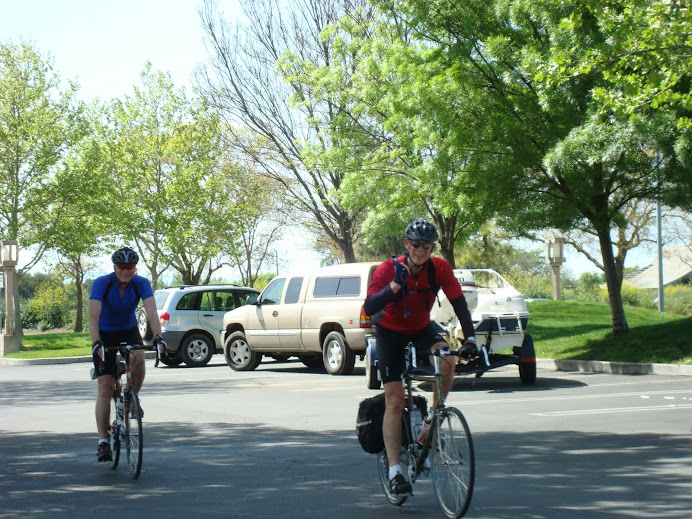

Nine riding days left! It helps to put that in perspective when I realize that nine days ago we were back in Patricia Lake, Wisconsin, but it still seems like it’s getting close. So far, the new route we put together yesterday afternoon is working out well. Today was 80 miles of good roads and much less traffic than we had yesterday. If you want to check your map, we’re in Port Loring, Ontario, in one of the nicest, prettiest, and friendliest RV parks we’ve had. No internet here, however, so this won’t get posted until tomorrow (Thursday) when Kathy can get to a hot spot. Port Loring is a nice quiet resort area with a number of lakes, and we’re right on one of them. It rained quite a bit last night, and through breakfast, but then not at all during the ride. Then the thunderstorms broke loose after we arrived and could go safely inside the motor home. Can’t ask for better than that!
It’s past time to write about bicycles. I spend some time each day focusing on the chain on Rich’s bike coursing over the rear cogs and through the derailleur, marveling at the simplicity of the system. Did you know that bicycles are the most efficient means of transportation ever developed? They do a fantastic job of converting energy into forward motion. It’s often said that it takes just 35 calories to propel yourself one mile on a bike. Of course, that depends on a lot of variables, including your size, the type of bike, speed, etc, but it’s considerably fewer calories than walking, and a car requires over 1,800 calories per mile.
The basic form of a bicycle hasn’t changed since around 1880. You have wheels, frame, handlebars, pedals, and a chain. The chain is perhaps the most remarkable component, because it performs the efficient transfer of energy from the pedal cranks to the rear wheel. I almost forgot the seat, one of the five places where your body contacts the bike, and an important control point.
Brakes have been added since the 1880s, and they are certainly a handy innovation. The other critical addition for touring cyclists is the very wide range of gearing, which makes it possible for us to conquer high mountains, yet still pedal efficiently on flat ground and even downhill. My bike, for example, in its highest gear, turns the rear wheel more than four times for every revolution of the pedals. In its lowest gear, the rear wheel makes just ¾ of a full turn for every pedal revolution. From low to high, that’s a much wider range than on any car.
All in all, our bikes are remarkably simple and effective machines, and I think that’s one of the reasons we do what we do – we really like to appreciate and enjoy this marriage of person and machine.
It’s past time to write about bicycles. I spend some time each day focusing on the chain on Rich’s bike coursing over the rear cogs and through the derailleur, marveling at the simplicity of the system. Did you know that bicycles are the most efficient means of transportation ever developed? They do a fantastic job of converting energy into forward motion. It’s often said that it takes just 35 calories to propel yourself one mile on a bike. Of course, that depends on a lot of variables, including your size, the type of bike, speed, etc, but it’s considerably fewer calories than walking, and a car requires over 1,800 calories per mile.
The basic form of a bicycle hasn’t changed since around 1880. You have wheels, frame, handlebars, pedals, and a chain. The chain is perhaps the most remarkable component, because it performs the efficient transfer of energy from the pedal cranks to the rear wheel. I almost forgot the seat, one of the five places where your body contacts the bike, and an important control point.
Brakes have been added since the 1880s, and they are certainly a handy innovation. The other critical addition for touring cyclists is the very wide range of gearing, which makes it possible for us to conquer high mountains, yet still pedal efficiently on flat ground and even downhill. My bike, for example, in its highest gear, turns the rear wheel more than four times for every revolution of the pedals. In its lowest gear, the rear wheel makes just ¾ of a full turn for every pedal revolution. From low to high, that’s a much wider range than on any car.
All in all, our bikes are remarkably simple and effective machines, and I think that’s one of the reasons we do what we do – we really like to appreciate and enjoy this marriage of person and machine.

No comments:
Post a Comment